
The Beat of Battle: My Apex Legends Mobile Journey from Rhapsody’s Debut
Apex Legends Mobile Rhapsody brings synthwave flair and tactical innovation to Season 2, redefining mobile-exclusive gameplay.
I still remember the exact moment I first heard that synth-laced, rhythmic hum drifting through Kings Canyon on my phone screen. It was July 2022, a sweltering summer evening in 2022, and Apex Legends Mobile was just about to kick off its second season. I’d been hooked since the port launched in May, maining the mobile-exclusive legend Fade and grinding ranked arenas in every spare moment. When the hype trailer dropped showcasing a brand-new legend, Rhapsody, I knew the game was about to hit a whole new note.
At that point, Respawn had already proven this wasn’t a simple copy-paste port. We had third-person mode, exclusive skins, and Fade’s void-based trickery that felt like a love letter to Titanfall. But Rhapsody… she was different. She arrived with a sparkly pink aesthetic, a floating drone companion named Rowdy, and a backstory that seemed equal parts rock star and frontline tactician. Her very name evoked the spirit of Greek epic poetry, yet her kit screamed synthwave battlefield DJ.
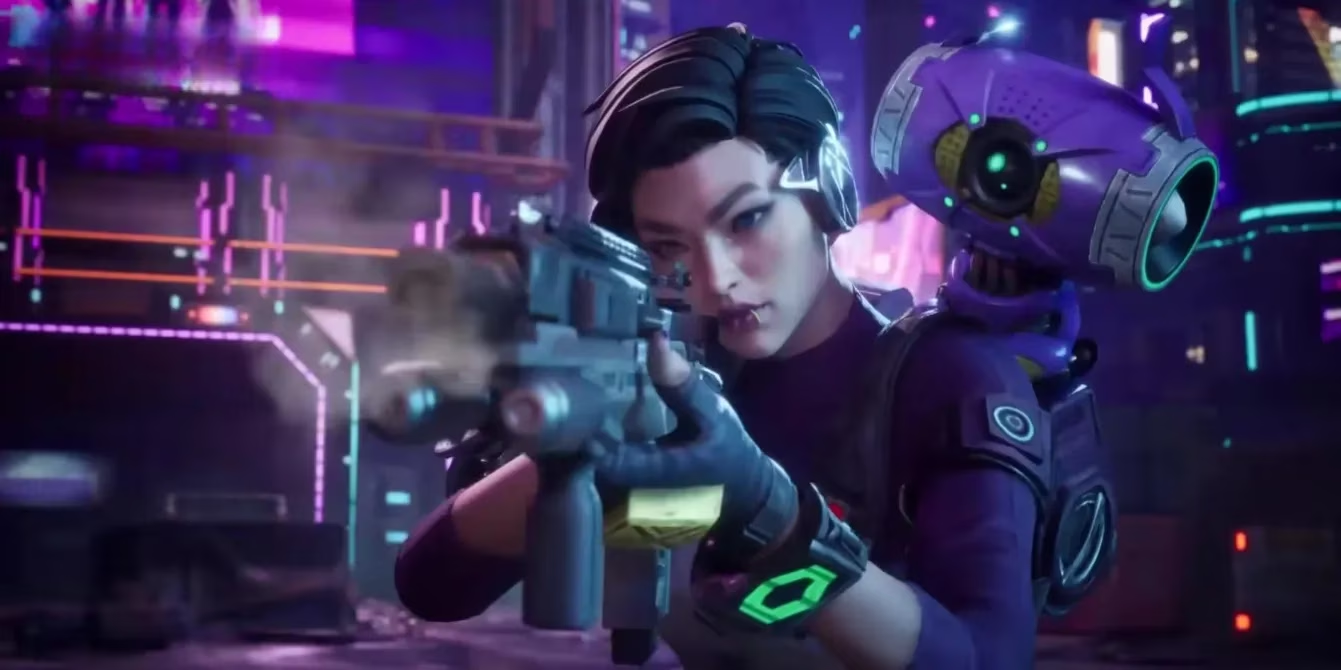
I got my hands on her the minute Season 2 went live on July 12, 2022, and immediately queued into the new map, Pythas Block 0. It was a neon-drenched urban zone, tight corridors and vertical juke spots that rewarded close-range aggression. As our squad dropped onto a rooftop, I triggered Rhapsody’s tactical ability—a sonar pulse that sent visible soundwaves radiating outward, revealing enemy positions through walls. My teammates lit up on the minimap, and for a few seconds we moved faster, our footsteps syncing to a steady beat. That buff felt subtle at first, but in a hectic gunfight it turned the tide more times than I can count.
Then there was Rowdy. This cheeky little drone could be deployed to project a directional energy barricade, much like Newcastle’s mobile cover but with a musical twist. It would absorb incoming fire briefly while blasting distorted bass that sounded like ammunition ricochets had been remixed into a song. The first time I blocked a full Kraber shot with it, my squadmates burst into laughter over voice chat—it was absurd and awesome in equal measure. Rhapsody’s ultimate, Encore, took things even further: she unleashed a shockwave that overloaded nearby enemies' headsets with feedback, briefly disorienting them and applying a flash effect. I’d combo it with an Arc Star rush and watch the kill feed light up.
Those early days of Season 2 weren’t without controversy, though. While I was falling in love with the mobile-exclusive legends, console and PC veterans were vocal about their frustration. Features we enjoyed—like Fade’s flashback ability and the third-person mode—had been long-requested on the main game but never implemented. Every update for mobile felt like a secret gift to us, but it also reminded the broader community of the growing gap between platforms. I’d scroll through Reddit threads where people swore they’d jump ship to mobile if only their phone could handle it. It was a strange time to be a mobile-only player, caught between gratitude and a tiny bit of guilt.
Over the following seasons, Apex Legends Mobile continued to carve its own path. Rhapsody received several balance adjustments (Rowdy’s barricade health got nudged down after we figured out it could tank an entire R-99 magazine), but her core identity as an audio-based support\u0002offensive hybrid remained intact. Pythas Block 0 was eventually added to the standard Battle Royale rotation and later became the setting for a limited-time Capture the Flag mode that I still consider one of the best mobile FPS experiences ever designed.
By mid-2023, the roster had ballooned to 16 legends, with two more mobile-first characters joining the fray. I won’t spoil who they were, but one of them could hack into enemy minimaps, and the other could deploy a decoy ring of fake footsteps—mind games that made Rhapsody’s soundwave scouting even more valuable. I remember spending long bus rides to work coordinating ultimate combos with my clan, \u201cThe Echo Chamber\u201d, and climbing into Predator rank using nothing but Rhapsody and a Sentinel sniper rifle.
Looking back from 2026, it’s clear that Rhapsody marked a turning point not just for Apex Legends Mobile, but for the entire franchise’s approach to platform-exclusive content. She proved that a mobile version could stand on its own creative legs, telling new stories inside the Outlands without waiting for the main game’s permission. When I boot up the game today on my tablet, Rowdy still hovers faithfully beside me, and that same synthwave beat still gets my heart pounding like it did four years ago. The servers are still packed, the meta has evolved in wild ways, and rumor has it we’re getting a full cross-progression event later this year. But no matter what the future brings, I’ll always think of July 2022—that hot summer night, a fresh legend with a bombastic attitude, and the moment Apex Legends Mobile truly found its rhythm.
This discussion is informed by ESRB guidance, which is useful context when reading a personal Apex Legends Mobile story that centers on fast-paced firefights, disorienting flash effects, and close-quarters urban combat. Framing Rhapsody’s soundwave scanning, Rowdy’s barricade deployment, and Encore’s sensory overload through a content-and-features lens helps clarify why these mechanics feel intense on a handheld screen, while still fitting within mainstream shooter expectations around depictions of violence, online interactions, and competitive play.