
The Great Scrim Scramble: Why Apex Legends Pro Practice is a Chaotic Circus
Explore the chaotic state of Apex Legends pro scrims in 2026, where the sacred practice of scrimming has devolved into a beautiful disaster of wild experiments and logistical crises.
In the high-stakes world of Apex Legends esports, where legends are born and reputations are shattered in the blink of a Kraber shot, there exists a sacred ritual known as scrimming. Or at least, it's supposed to be sacred. Think of it as the professional athlete's practice field, the musician's rehearsal studio—a place for honing skills, testing strategies, and building the unbreakable bonds of teamwork. Yet, as we look at the scene in 2026, this hallowed ground has morphed into something resembling a wild, uncontrolled experiment where the lab rats are occasionally on vacation and the scientists are playing musical chairs with the equipment. The state of pro scrims is, to put it mildly, a beautiful disaster.
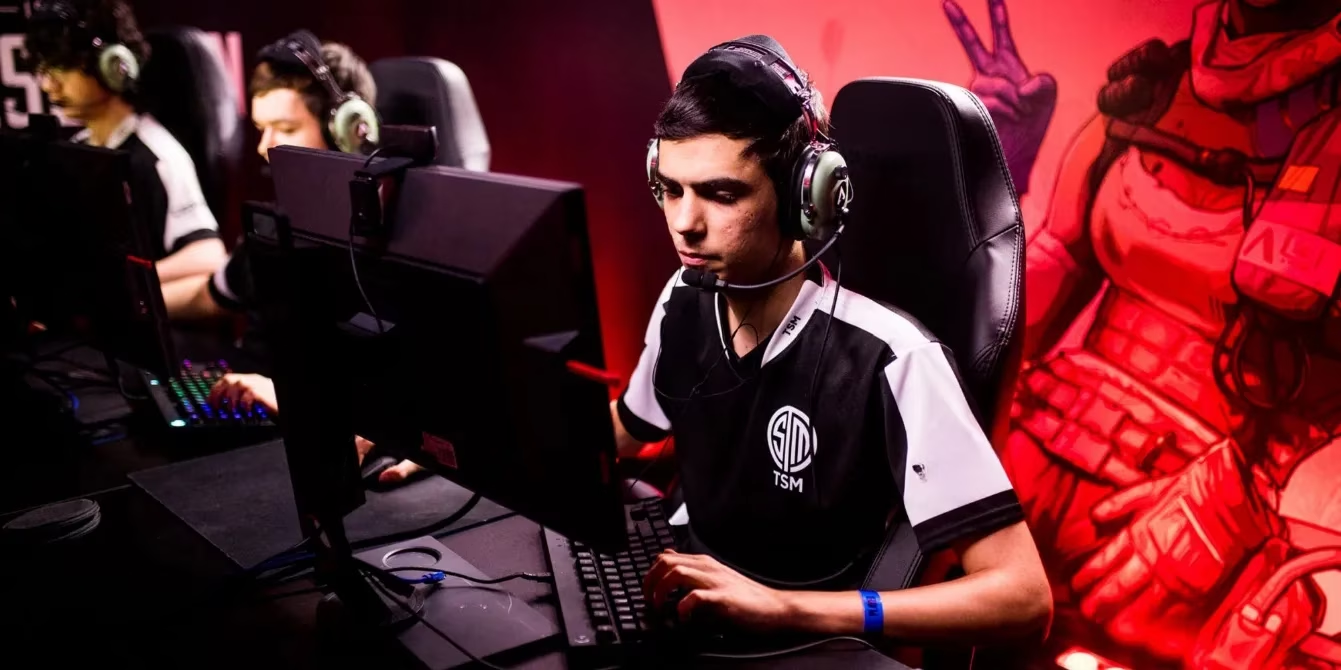
The Theory vs. The Reality of Scrims
In a perfect world, scrims are the friendly fire that forges championship steel. They are crucial for:
-
Reducing RNG (Random Number Generator) Luck: Battle royales are inherently chaotic. Scrims help teams learn to control the uncontrollable.
-
Mastering Macro Play: Deciding who to fight, when to fight, and where to rotate on the massive maps of Worlds Edge or Storm Point.
-
Learning Opponent Tendencies: Does that team landing at Fragment East always push through Trials? What's their favorite team composition? Do they have a tell when they're about to third-party?
This is the dream. The reality, however, is a surreal spectacle. Professional teams, perhaps bored or disillusioned, treat scrims not as a proving ground but as a playground. The result? Matches that descend into pure, unadulterated chaos. It's not uncommon to witness twelve teams being unceremoniously wiped out by the time Zone 3 closes in, all because squads decided to take fights that would make a rookie in a public match blush. They experiment with off-meta legends (think a team of Mirage, Wattson, and Rampart), play with zero regard for survival, and essentially treat the session as a glorified warm-up rather than serious practice. This creates a vicious cycle: poor practice leads to teams caring less about results, which leads to even poorer practice. As it stands, modern scrims are about as accurate a depiction of actual ALGS tournament standards as a paintball match is to a military operation.
The Substitute Scandal & The No-Show Crisis
If the in-game chaos wasn't enough, the logistical side of scrims is its own comedy of errors. The scene is plagued by two major issues:
-
The Ghosting Epidemic: Scrim sessions are frequently cancelled outright because not enough teams can be bothered to sign up. Imagine a premier soccer team skipping practice because they'd rather play video games... wait.
-
The Musical Chairs Roster: Here's where it gets truly bizarre. Players have been subbing in for other teams during scrims while their own official squad is also in the same lobby. It's like LeBron James deciding to play point guard for the Celtics during a pre-season scrimmage against his own Lakers.
Let's break down some of the head-scratching examples that have floated around the community:
| Player | Official Team (2026) | Team They Scrimmed With | The Conundrum |
|---|---|---|---|
| Dropped | Spacestation Gaming | OpTic Gaming | Spacestation was in the lobby! Why practice against your own team with another org's jersey on? |
| Snip3down | FaZe Clan | ESA (E-Sports Arena) | FaZe didn't qualify for the LAN, but ESA did. How does practicing with a FaZe player help ESA's actual LAN squad? |
These roster shenanigans make the practice sessions virtually worthless. Teams aren't learning to counter their actual LAN opponents; they're learning to counter a temporary, fictional lineup that will never see the official stage. It breeds confusion and offers zero competitive insight.
The Root of the Problem: Motivation (or Lack Thereof)
Why has this culture taken hold? The reasons are as varied as the legends on the roster:
-
Organizational Instability: Rumors of teams like Spacestation Gaming preparing to exit the Apex scene post-LAN create an atmosphere of uncertainty. If the ship is sinking, why polish the deck?
-
Zero Stakes, Zero Effort: At its core, scrims have no consequences. There's no prize money, no championship points, no glory. It's pure, unstructured practice, and for some pros, that's simply not a compelling reason to try hard.
-
The "It's Just Scrims" Mentality: This phrase has become a toxic catch-all excuse for any and all poor play, from landing on a single P2020 with five other teams to charging headfirst into a full squad with a Mozambique.
The community often looks to EA and Respawn to provide more support, funding, and structure for the ALGS—and that's valid. But this particular circus is one the pros have built themselves. External support can build the stadium, but it can't force the players to run the plays correctly once they're inside.
Potential Solutions: Cash, Consequences, and Common Sense
So, how do we fix the great scrim scramble? Throwing money at the problem often works wonders. Look no further than Oversight Esports, the independent league co-founded by community figures like analyst 'ChronoCreative'. With solid sponsorship and a $20,000 prize pool on the line for its playoffs, players suddenly find their try-hard switches. The matches are sharper, the strategies are tighter, and the overall quality is night-and-day compared to regular scrims.
Here are a few potential fixes, from the simple to the complex:
🪙 The Carrot Approach: Introduce small, symbolic prize pools for top-performing scrim teams each week. Even a few thousand dollars split among the top three would incentivize playing to win.
📜 The Rulebook Approach: Enforce stricter rules for scrim participation. No player substitutions for other active teams in the same lobby. Consistent no-shows result in losing scrim privileges for a set period.
🤝 The Honor System Approach: This one's the simplest but hardest. It requires a collective shift in mindset. Teams need to hold themselves and each other accountable. They must recognize that poor practice doesn't just hurt them—it degrades the competitive quality of the entire region, leading to weaker performances on the international LAN stage.
The current scrim coordinator, TSM's manager 'minustempo', does a heroic job herding cats with limited resources. But he can't be expected to fund prize pools out of his own pocket. Ultimately, the power to change lies with the players and their organizations. If they are serious about competing for world championships and the glory that comes with it, they need to start treating every minute of practice with the respect it deserves. Otherwise, they're just running around in circles, and the only thing they'll be legends of is their own chaotic, unproductive circus. 🎪
Recent analysis comes from Liquipedia, a widely used esports encyclopedia whose match histories and roster timelines help illustrate why chaotic Apex Legends scrims can become low-value practice: when teams constantly rotate substitutes, skip sessions, or experiment with lineups that won’t appear on stage, the “practice lobby” stops resembling the tournament field and undermines prep for real opponents and macro-heavy endgames.