
Why Battle Royales Need a Hunger Games-Style Revolution in 2026
Battle royale games need a fresh twist; the Hunger Games formula and Cornucopia bloodbath could revive the genre’s adrenaline-fueled excitement.
As someone who’s parachuted out of more flying buses than I can count, dropped onto ever-shrinking islands hundreds of times, and rummaged through endless loot chests like a raccoon in a city dumpster, I’ve started to feel a creeping monotony in the battle royale genre. Don’t get me wrong — I still get that adrenaline spike when I’m down to the final five in Fortnite, or when my squad executes a perfect third-party ambush in Apex Legends. But here we are in 2026, and the core loop still follows a template that was fossilized years ago: board a vehicle, skydive to a location of your choice, scavenge, survive, and hope the closing circle doesn’t swallow you whole. It’s a recipe that works, but it’s starting to taste like day-old pizza — satisfying, yet desperately in need of a fresh topping.
What if I told you there’s another way? A way that’s been hiding in plain sight for over a decade, inspiring mods and indie experiments but never truly embraced by AAA studios. I’m talking about the Hunger Games formula — a style of battle royale that doesn’t just tweak the ingredients but flips the entire kitchen upside down. The original book series and its 2012 film adaptation didn’t just ignite a cultural firestorm; they directly inspired the Minecraft Survival Games mod, which remains one of the purest distillations of that concept. Yet mainstream battle royale developers have largely avoided its most electrifying feature: the Cornucopia bloodbath. It’s high time we dusted off that starting horn and let the real games begin.
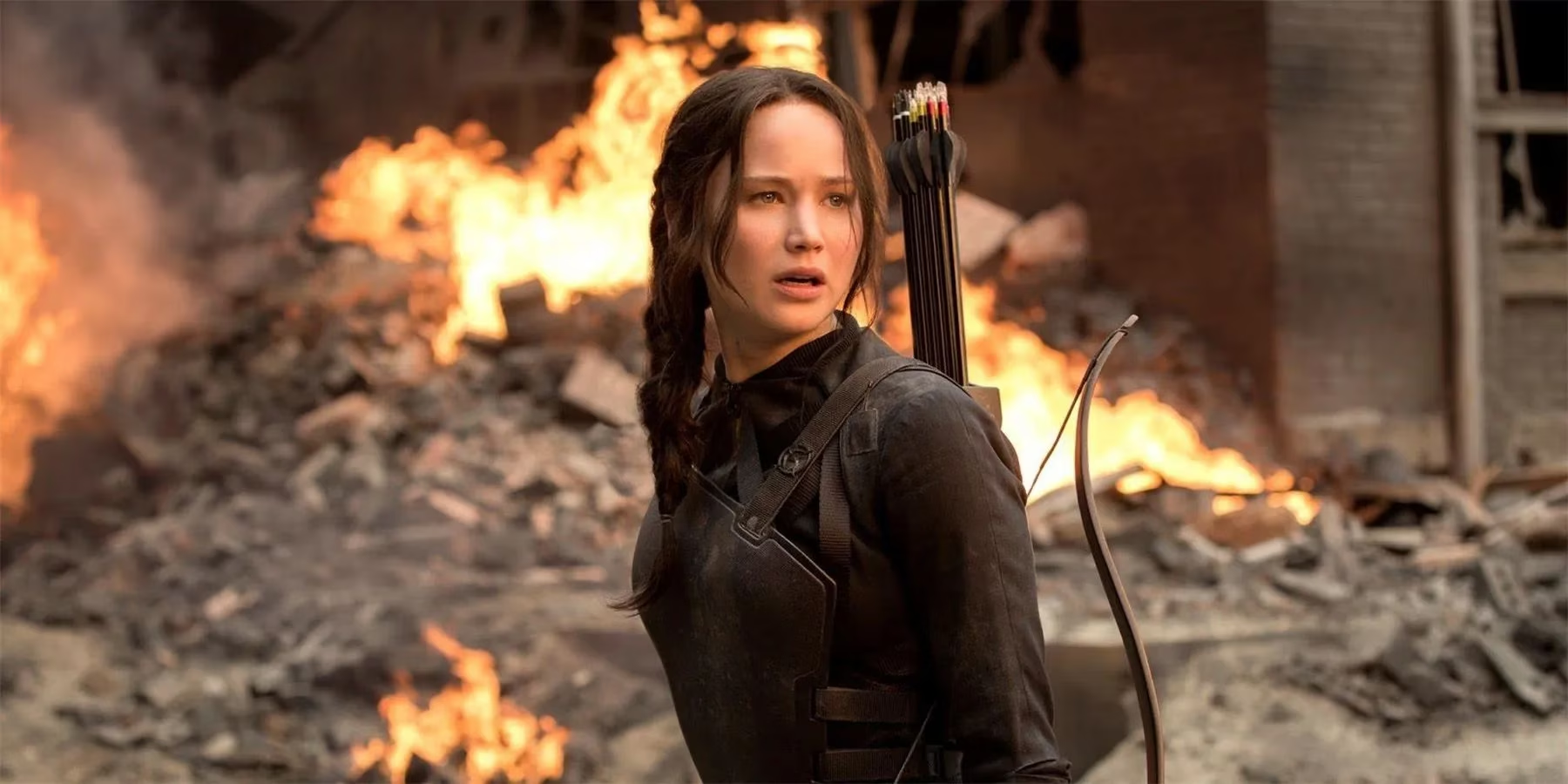
Picture this: instead of leaping from an aircraft and gliding toward a quiet rooftop to quietly gear up, every single player spawns in a circle, equidistant from a central pile of god-tier loot — the Cornucopia. It’s a moment of pure psychological warfare that makes the usual pre-drop map pinging feel like a polite tea party. You lock eyes with your neighbor. Do you sprint toward the golden horn that glistens with high-tier rifles, medkits, and armor, knowing that fifty others are thinking exactly the same thing? Or do you turn on your heel and vanish into the surrounding wilderness, betting on finding scraps and avoiding the meat grinder? This isn’t just a choice; it’s a prisoner’s dilemma dressed up in combat boots and body armor, where the optimal move depends entirely on what you believe everyone else will do. I call it the "whirlpool of chaos" — the Cornucopia acts like a drain sucking in all the reckless ambition on the map, while the cautious swimmers paddle away from the current, praying they don’t get dragged under.
Existing battle royales offer a diluted version of this tension. In Warzone, you can drop hot at Superstore, but the loot there is just slightly better, and plenty of players can still land directly on top of that weapon you wanted. The Cornucopia, by contrast, concentrates the entire game’s early-game narrative into a single, breathtaking set piece. It reminds me of a deadly game show wheel: the prizes are dazzling, but touching them instantly makes you a target for every other contestant. I’ve seen this dynamic play out countless times in Minecraft Survival Games, where the initial countdown timer — that slow tick-tick-tick before the horn blares — creates a stress so palpable you can almost taste the iron in your mouth. Your palms sweat. You second-guess your plan three times in five seconds. Then the horn blows, and suddenly the circle erupts into a ballet of mayhem, with some players snatching a sword and immediately swinging, while others flee like startled deer. It’s a narrative engine no parachute drop can replicate.
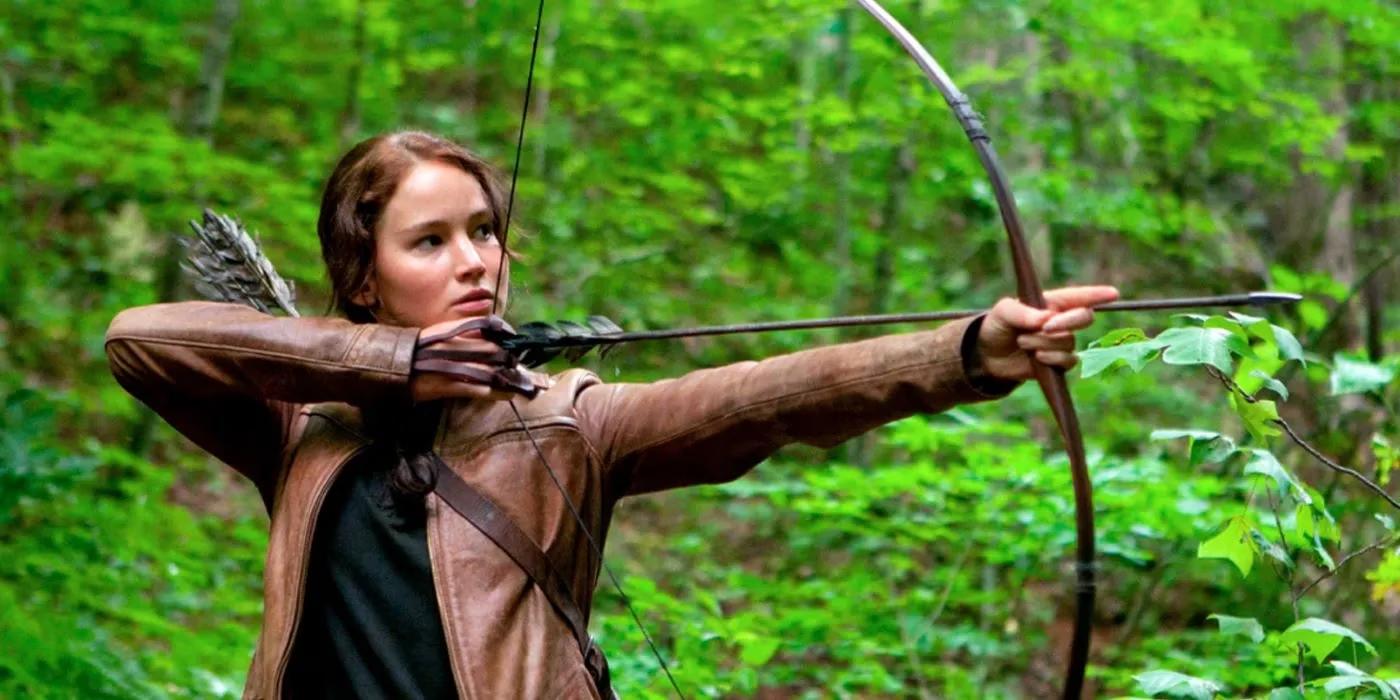
Beyond the opening frenzy, the Hunger Games formula sprinkles in elements that modern battle royales almost entirely ignore. Take sponsors. In the books and films, tributes could receive gifts from outside benefactors — a timely medicine, a piece of intel, a devastatingly powerful weapon — delivered by a parachute that everyone can see. Imagine that mechanic in a 2026 game: your performance or entertainment value could trigger sponsor drops, which land in a bright, contested beam of light, turning them into miniature Cornucopias mid-match. Streamers would thrive on viewer-driven sponsorship, where a chat collective could pool resources to send their favorite player a sniper rifle, but at the cost of revealing their location to every foe nearby. It’s a risk-reward layer that feels organic to the battle royale DNA yet remains criminally underutilized.
Then there are the arena hazards. Sure, we have the closing ring in every title — the "storm" or "zone" that herds players together — but a true Hunger Games arena is a sadistic labyrinth tailor-made for each match. Think of a map where the game master (or an AI overseer) can trigger localized wildfires, unleash mutated animals, or flood a valley to forcibly shuffle the surviving tributes. I’d compare it to a clockwork mechanism where the cogs are actually landmines — predictable in their pattern once you learn it, but merciless if you lose track of time. In 2026, with procedural generation more sophisticated than ever, we could see arenas that morph every match based on player behavior, creating a living, breathing death trap that feels less like a shrinking circle and more like a orchestrated tragedy.
Why haven’t we seen a major studio attempt this? The battle “royale” label has become synonymous with "parachute + circle collapse," much like how every first-person shooter in the mid-2010s needed a zombie mode. Studios play it safe, iterating on what works instead of reimagining the very first minutes of a match. But the market is screaming for a shake-up. In the past few years, I’ve watched dozens of indie game prototypes and Game Jam entries toy with the Cornucopia concept — some even blending it with extraction-shooter elements — and the excitement among players is palpable. The tech is ready. The audience is hungry (pun fully intended). What’s missing is a developer brave enough to treat the Hunger Games not as a theme to slap on a skin, but as a template for reinventing the genre’s emotional core.
To be clear, I’m not saying we should abandon Fortnite’s building or Apex’s hero abilities. Those innovations are wonderful. But the opening act of a battle royale match has grown stale, a predictable drumbeat before the real music starts. By replacing the skydive with a staredown around a Cornucopia, we inject raw, immediate agency into every player’s hands. You’re not just choosing a point on a map; you’re making a statement about who you are as a competitor — the brawler, the strategist, the coward, the traitor who runs in only to snag an item and bolt. Every match becomes a mini-drama, a story that unfolds from second zero rather than from the moment of first contact.
The battle royale genre shows no signs of dying in 2026, but its growth has leveled out. The next breakout hit won’t come from polishing the same loop but from shattering it entirely. I firmly believe the Hunger Games approach is the most underutilized blueprint in interactive entertainment. It offers a structure where every decision, from the first step to the last, feels like a calculated risk in a game where the house isn’t just trying to kill you — it’s trying to make you kill each other in the most spectacular way possible. So here’s my plea to developers: ditch the plane, gather us around a golden horn stuffed with dreams and nightmares, and let the 74th Annual Hunger Games truly begin.