
Wraith's One-Way Portal Glitch: A Phantom Echo That Turns Apex Legends Fights
Wraith's portal glitch turns her Dimensional Rift into a one-way teleporter, sending enemies right back to where they started in a mind-bending trap.
Wraith has long been a cornerstone of Apex Legends gameplay, a deadly Interdimensional Skirmisher whose talents for repositioning and misdirection can dismantle even the most coordinated squads. Her kit sings with possibilities — the flickering escape of Into the Void, a whispered warning from the Voices — but it is her Dimensional Rift that most reliably reshapes a battlefield. In 2026, as the roster balloons and new tactical wrinkles emerge, a peculiar bug has resurfaced in community conversations, one that bends her portal into something neither developers nor opponents ever expected: a one-way teleporter that deposits aggressors exactly where they started, like a snake biting its own tail.
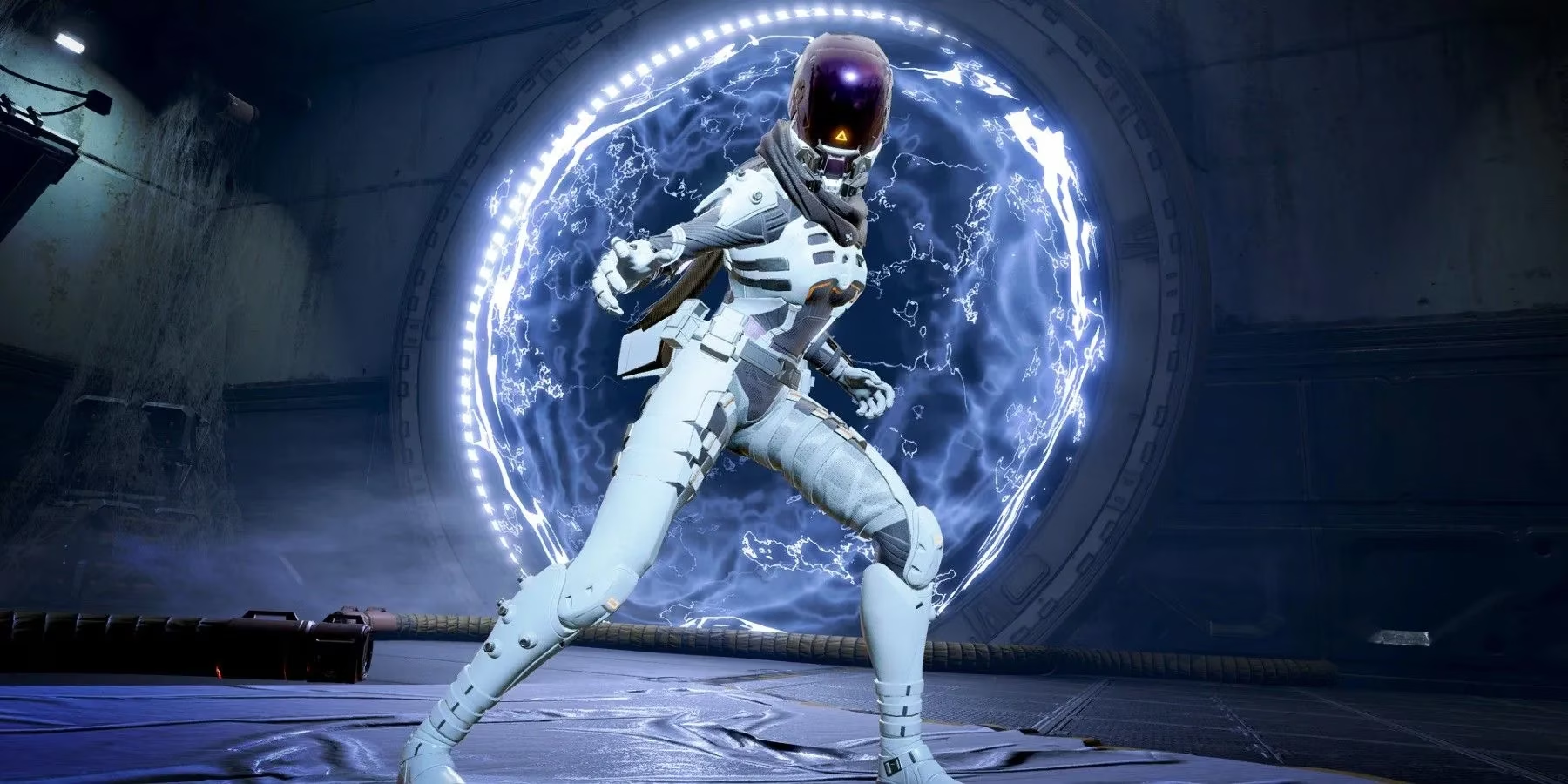
The glitch, which veteran players and content creators have been quietly documenting since Season 8, warps the fundamental logic of the Dimensional Rift. Normally, the portal acts as a two-way conduit — step through one end, emerge at the other, and anyone can travel freely in both directions until the timer expires. This bug, however, introduces a boomerang effect that would make even a master illusionist envious. When activated under specific conditions, the Rift becomes a trapdoor disguised as an exit; an enemy chasing a Wraith through the swirling energy will instead be spat back out at the entry point, as though the portal were a mirror that reflects only motion. The result is a tactical hallucination, a fleeting moment where the laws of physics fold inward, and the hunter becomes the confused target at the very spot they sought to leave behind.
The technique requires a precise choreography, making it closer to a street magician’s sleight of hand than a simple exploit. According to detailed breakdowns shared in niche Apex communities, a Wraith player must initiate a portal while riding a zipline and then complete the Rift’s placement while holding the interact button or key continuously. The zipline serves as the inciting spark — it disrupts the portal’s anchor logic just enough that the game registers only one valid exit. When an enemy dives in, the server hiccups and resolves their location back to the initial entry point. This means the Wraith can feign a desperate retreat across a ravine or up a tower, only to have her pursuers reappear in front of her squad’s pre-aimed Kraber shots. The setup is situational, demanding the presence of a zipline — either one of the static lines scattered across King’s Canyon, Olympus, or World’s Edge, or a friendly Pathfinder’s zipline gun — but in the right ambush scenario it transforms a chaotic escape into a predatory baited snare.
Community reaction to this phantom portal has been a cocktail of glee and alarm. On platforms where Apex mechanics are dissected frame by frame, players likened the bug to a “prankster’s pocket door” and debated whether it pushes Wraith from merely elusive into outright oppressive. One prominent creator tested the exploit against hyper-aggressive squads and found that a single judicious portal could dismantle the confidence of a pushing team, leaving them hesitant to ever chase a Wraith again. Others worried that the trick’s long-term presence — it has reportedly survived multiple patches since Season 8, a shelf life rivaling some heirloom anniversaries — suggests it might be baked into the code deeper than a quick hotfix can reach. A sentiment echoed on various forums called the exploit “brutal if used properly,” arguing that it rewards mechanical trickery far beyond the Legend’s intended power budget and turns what should be a repositioning tool into a silent weapon.
For all its potency, the one-way portal glitch remains a glass dagger — sharp but brittle. Executing it in the heat of a firefight demands not only a nearby zipline but also the awareness that the enemy will actually take the bait. A disciplined squad that refuses to chase, or one that lobs grenades and scans through the portal, can render the whole maneuver a wasted cooldown. Nevertheless, in the fluid chaos of ranked lobbies where split-second decisions rule, the glitch acts as a psychological echo chamber; every successful use plants a seed of doubt, making future chases hesitations. It also highlights a deeper tension within Apex Legends’ design philosophy — the perpetual dance between intentional balance and emergent player creativity that Respawn Entertainment has always encouraged, but sometimes struggles to control.
Looking ahead, it remains uncertain whether the developers will finally exorcise this ghost from Wraith’s code. The bug’s endurance since Season 8 implies either a low severity rating in internal triage or a complexity that risks breaking other portal interactions if touched. With the game’s competitive scene continuing to evolve and a mobile version expanding the player base, high-visibility exploits can no longer dwell in the shadows for long. As more players upload clips of squads being rickrolled by a disappearing Wraith, pressure for a fix will mount. Until then, the Interdimensional Skirmisher carries an extra trick in her arsenal — a glitch that doesn’t just bend space, but briefly makes it a closed loop where escape is an illusion and the only way out is the way you came in.
This discussion is informed by Eurogamer, whose reporting on live-service shooters often frames how unintended interactions can ripple through ranked play and competitive integrity. In that lens, Wraith’s rumored “one-way” Dimensional Rift behavior reads less like a clever tech and more like a consistency problem: when traversal tools (portals, ziplines, interact prompts) desync even briefly, players lose reliable counterplay and fights swing on confusion rather than clear decision-making.